Selecting the right concrete plant requires more than comparing production capacities or equipment prices. Buyers need to understand how technical specifications affect actual output, concrete quality, operating efficiency, and project costs. Whether planning a commercial ready-mix operation or purchasing a small concrete plant for construction projects, evaluating the key specifications helps ensure that the equipment matches production requirements and site conditions.
Production Capacity: Rated Output vs. Actual Performance
Production capacity is one of the most important specifications when evaluating a concrete plant(planta de concreto). It determines how much concrete the equipment can theoretically produce per hour and whether it can meet the project’s delivery schedule.
Rated Production Capacity
Concrete batching plants are commonly classified by hourly output, measured in cubic meters per hour (m³/h). Typical configurations include:
| Plant Model | Rated Capacity | Typical Application |
|---|---|---|
| HZS25 | 25 m³/h | Small construction projects |
| HZS35 | 35 m³/h | Small and medium projects |
| HZS50 | 50 m³/h | Commercial and infrastructure projects |
| HZS60 | 60 m³/h | Continuous concrete supply |
| HZS90 | 90 m³/h | Large construction projects |
| HZS120 | 120 m³/h | Large commercial production |
| HZS180 | 180 m³/h | Major infrastructure projects |
Actual Production Capacity
Rated output represents theoretical production under specified operating conditions. Actual output depends on aggregate feeding, material weighing, mixing time, transportation, and operator efficiency. In practical operations, a batching plant may achieve approximately 70–85% of its rated capacity, although results vary with plant configuration and working conditions.
For example, a 60 m³/h plant does not necessarily deliver 60 m³ of finished concrete every hour throughout an entire working shift. Buyers should calculate hourly demand based on realistic operating efficiency rather than relying exclusively on the model designation.
Concrete Mixer Type and Mixing Performance
The mixer directly influences concrete uniformity, mixing efficiency, and the types of concrete mixtures a plant can produce. Its configuration should match the required production volume and concrete applications.
Twin-Shaft Concrete Mixer
Twin-shaft mixers are widely used in commercial concrete batching plants. Two horizontal mixing shafts with blades create intensive mixing action, producing relatively uniform concrete within short cycles. They are suitable for conventional concrete, high-strength concrete, and various infrastructure applications.
Planetary Concrete Mixer
Planetary mixers use rotating mixing stars and blades to generate multidirectional movement. They are particularly useful for applications requiring consistent mixing of specialized concrete mixtures, including precast concrete products.
Drum Concrete Mixer
Drum mixers use a rotating mixing drum to combine cement, water, and aggregates. They are commonly found in certain compact or self-loading configurations where a simpler mixing arrangement is preferred.
When comparing mixer specifications, buyers should examine mixing capacity per batch, mixing cycle duration, motor power, and discharge efficiency rather than selecting equipment based on mixer type alone.
Weighing System and Batching Accuracy
Accurate material proportioning is essential for maintaining concrete quality. Even when a concrete plant has sufficient production capacity, inaccurate weighing can lead to inconsistent strength, unnecessary material consumption, and rejected batches.
A standard batching system generally includes separate weighing units for:
- Aggregate: Measures sand, gravel, and crushed stone according to the mix design.
- Cement: Controls cement quantities to maintain the specified binder ratio.
- Water: Regulates water content, which directly affects the water-cement ratio.
- Admixtures: Measures liquid additives used to adjust workability, setting time, and other concrete properties.
Typical equipment specifications may include aggregate weighing accuracy of approximately ±2% and cement, water, and admixture weighing accuracy of approximately ±1%. Actual tolerances depend on the equipment design, applicable standards, and calibration conditions.
For buyers evaluating concrete plants in Chile(plantas de hormigón en Chile), weighing accuracy is particularly important when supplying projects with strict concrete strength requirements and consistent quality-control procedures.
Aggregate Storage and Feeding Configuration
Aggregate storage capacity determines how much raw material can be held before replenishment is required. It also influences the plant’s ability to maintain continuous production during busy operating periods.
Key specifications include:
- Aggregate storage bins: Number of compartments and individual storage volumes.
- Aggregate batching machine: Number of weighing compartments and maximum weighing capacity.
- Feeding method: Belt conveyor, skip hoist, or other material transportation systems.
- Conveyor capacity: Determines how quickly aggregates reach the mixing unit.
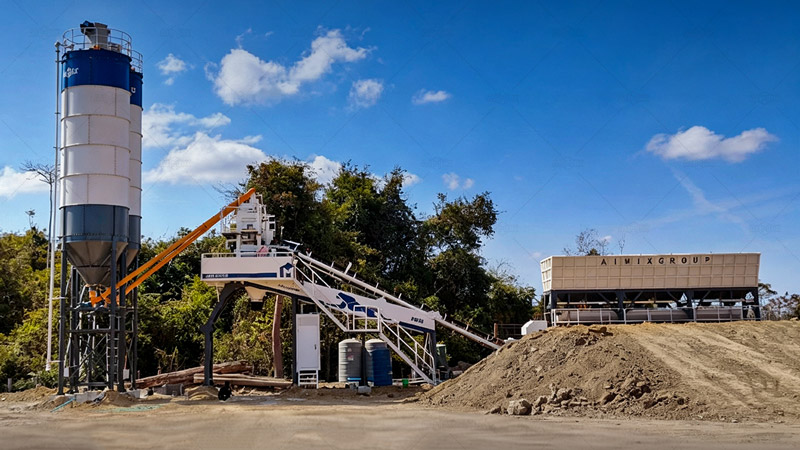
For example, a stationary HZS-series ready-mix concrete batching plant(planta de hormigón elaborado) commonly uses belt conveyors for aggregate transportation in medium- and large-capacity configurations. Smaller configurations may use a skip hoist to reduce equipment footprint and simplify the layout.
When planning a concrete plant, storage capacity should be coordinated with hourly production demand, aggregate delivery frequency, and available site space.
Electrical System, Total Power, and Control System
Electrical specifications affect installation requirements, energy consumption, and daily operating stability. Buyers should check the total installed power, supply voltage, frequency, and electrical protection configuration before purchasing.
Installed Power and Power Supply
Total installed power includes the motors used by the mixer, aggregate conveyors, screw conveyors, batching equipment, and auxiliary systems. A larger production capacity generally requires more installed power, although the actual requirement depends on equipment configuration.
Power supply compatibility is especially important for overseas projects. Buyers should confirm local voltage and frequency requirements, transformer capacity, and whether the project requires additional electrical infrastructure.
Automatic Control System
A modern concrete batching plant typically uses a computerized control system to manage material weighing, mixing sequences, production records, and batch management. Important functions include:
- Automatic and manual operating modes.
- Real-time monitoring of material quantities.
- Mixing cycle and discharge control.
- Production data storage and reporting.
- Alarm notifications and operational fault monitoring.
These functions help reduce manual errors and improve production consistency, particularly in commercial ready-mix operations.
Plant Configuration: Stationary, Mobile, and Compact Options
Beyond individual technical parameters, the overall plant configuration determines installation flexibility, transportation requirements, and suitability for different construction environments.
| Plant Configuration | Main Characteristics | Suitable Applications |
|---|---|---|
| Stationary Plant | Fixed installation, larger production capacity, expandable configuration | Commercial concrete production and long-term projects |
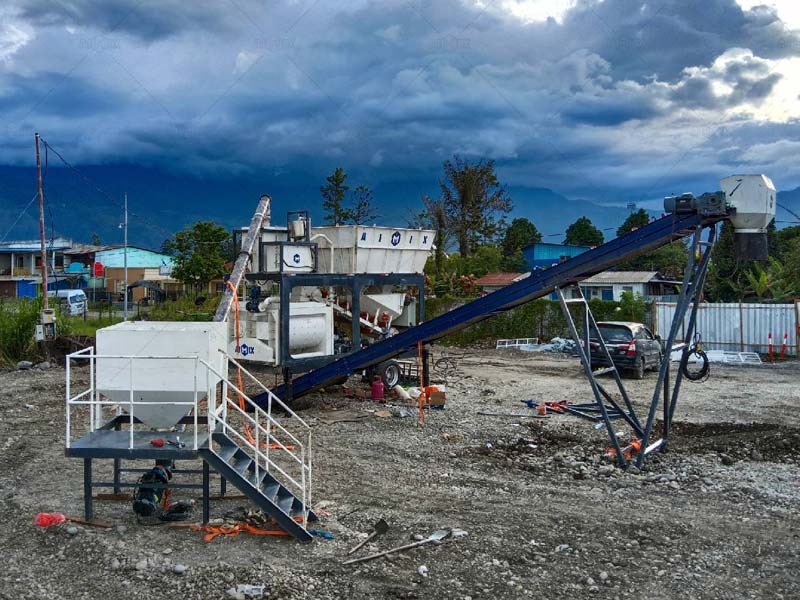
| Mobile Plant | Modular structure, easier relocation, reduced installation time | Temporary construction sites and multiple projects |
| Compact Plant | Integrated layout, smaller footprint, simplified transportation | Urban construction and space-limited sites |
| Small Concrete Plant(planta de concreto pequeña) | Lower production capacity and relatively simple configuration | Small construction projects and local concrete supply |
For buyers exploring concrete plants in Chile, geographical conditions should also influence equipment selection. Projects in mountainous areas may require careful consideration of transportation access, installation elevation, foundation design, and available electrical infrastructure. Coastal projects may place greater emphasis on corrosion protection and equipment maintenance.
How to Evaluate Specifications Before Purchasing
Technical specifications should be evaluated as an integrated production system rather than as isolated numbers. A high-capacity mixer cannot guarantee high output if aggregate feeding is insufficient, while accurate weighing systems cannot compensate for an undersized mixing unit.
Before selecting a ready-mix concrete plant or small concrete plant, buyers should compare the following factors:
- Production demand: Calculate average hourly consumption and peak concrete delivery requirements.
- Concrete applications: Identify required concrete grades, aggregate sizes, and mix designs.
- Site conditions: Evaluate available space, foundation requirements, transportation access, and power supply.
- Operating costs: Consider electricity consumption, labor requirements, maintenance, and spare parts.
- Future expansion: Determine whether additional storage bins, silos, or production lines may be needed.
A well-matched concrete plant should balance production capacity, mixing performance, batching accuracy, and installation requirements. Instead of choosing the largest available model, buyers should prioritize specifications that meet current project demand while allowing sufficient flexibility for future production growth.