In the heavy precast industry, the Double Girder Gantry Crane is the backbone of production. Its structural rigidity and high hook height make it ideal for handling massive concrete girders, bridge segments, and wall panels. However, the sheer scale of these operations means that any equipment failure or procedural oversight can result in catastrophic structural damage or loss of life.
Maintaining a zero-incident environment requires moving beyond basic industrial gantry crane operation. It demands a rigorous adherence to safety protocols that bridge the gap between mechanical capacity and the unique physical properties of “green” or cured concrete.
1. Structural Integrity: The Pre-Lift Verification
Safety in precast lifting begins before the winch is ever engaged. Because precast elements are often lifted while the concrete is still maturing, the structural readiness of the load is the first safety gate.
-
Concrete Strength Calibration: Lifting a panel before it has reached the required compressive strength (often specified at 75% of design strength) can lead to anchor pull-out. Protocol dictates that field-cured cylinders must be tested and documented before the “all-clear” is given.
-
Anchor Point Inspection: Every lifting socket, cast-in anchor, or bolt must be inspected for alignment. An anchor cast at a slight angle can create eccentric loading, significantly reducing its safe working load (SWL) and potentially shearing the concrete “cone” around it.
2. Double Girder Gantry Specifics: Redundancy and Stability
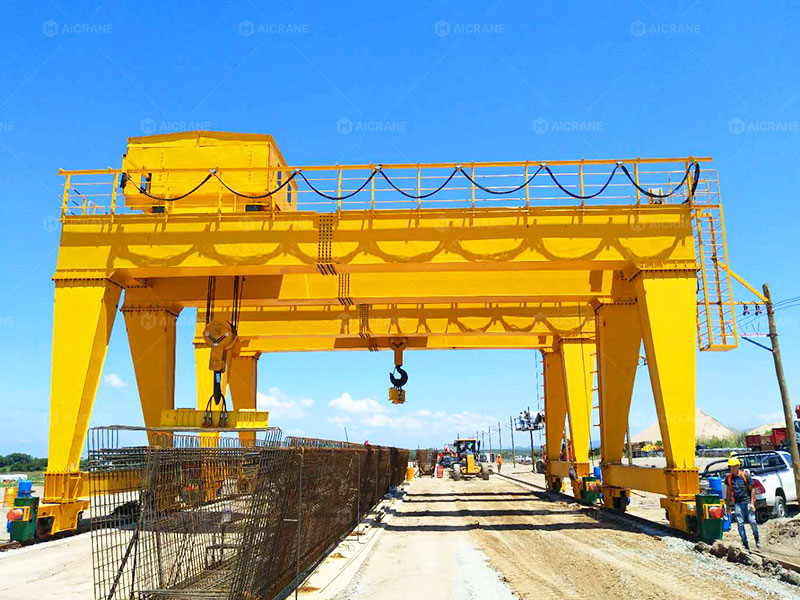
The double girder configuration offers superior stability compared to single girder designs, but it introduces specific maintenance requirements that are critical to safety.
-
Trolley Synchronization: Most double girder gantry cranes use a heavy-duty trolley that travels across both beams. Safety protocols require a weekly check of the trolley wheel alignment and rail sweeps. If the trolley “crabs” or skews, it creates lateral stresses on the girders that can lead to metal fatigue over time.
-
Hoisting Redundancy: For critical infrastructure lifts, cranes should be equipped with dual-drum hoists or redundant braking systems. If a primary brake fails due to heat or wear, a secondary emergency brake – acting directly on the drum – must be capable of holding 125% of the rated load.
3. Rigging Geometry and the “Inward Crush” Factor
As discussed in previous technical modules, the geometry of the rigging is a primary safety variable. With double girder cranes, the hook height is often high, tempting crews to use shorter slings to save time. This is a high-risk practice.
-
Minimum Sling Angle: Protocol strictly prohibits horizontal sling angles of less than 45 degrees, with 60 degrees being the mandatory target for heavy beams. Shallow angles create massive inward horizontal forces. In a safety-first environment, Spreader Beams are used for any element exceeding 6 meters to convert these crushing forces into purely vertical tension.
-
Center of Gravity (CoG) Mapping: Every precast element should have its CoG clearly marked at the factory. The rigger-in-charge must verify that the crane hook is positioned directly over this mark. If the load tilts more than 5 degrees during the “initial tension” phase, the lift must be aborted and the rigging adjusted.
4. The “Initial Tension” and Suction-Break Protocol
The most dangerous moment of a lift is the transition from static to dynamic. In precast yards, this is complicated by form suction.
-
The 10% Rule: Operators should never apply full power to break a panel free from its mold. The protocol involves applying 10% of the estimated load weight as “tension,” then pausing to inspect the anchors and slings.
-
Suction-Breaking Tools: Mechanical wedges or air-injection systems should be used to break the vacuum seal between the concrete and the steel form. Relying on the gantry crane’s raw power to “tear” the panel out of the mold can cause sudden energy release, leading to a “snap-load” that can snap wire ropes or damage the crane’s gearbox.
5. Ground and Rail Safety: The Foundation of the Lift
A double girder gantry crane is a rail-mounted machine. Its safety is entirely dependent on the integrity of the track and the ground bearing capacity (GBC).
-
Rail Obstruction Clears: A single bolt or a piece of debris on the rail can derail a 100-ton gantry. Safety protocols require a designated “path-clearer” to walk the track before any travel operation.
-
End-Stop Verification: Magnetic limit switches and physical hydraulic buffers must be tested daily. These prevent the rail mounted crane from over-traveling and colliding with the end of the runway, which would cause the suspended precast load to swing violently.
6. Communication and Exclusion Zones
Human error remains a leading cause of lifting accidents. A standardized communication protocol is the “soft” infrastructure that prevents tragedy.
-
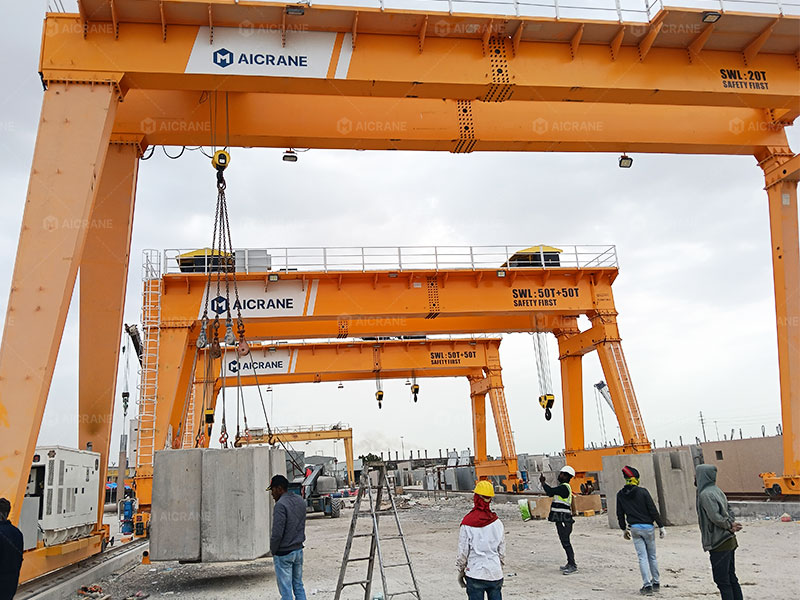
The “One Voice” Rule: Despite having multiple spotters, only one designated signal person (identifiable by a high-visibility vest of a different color) is permitted to give directions to the crane operator.
-
The Dynamic Exclusion Zone: The “danger zone” is not just the area directly under the load. It is a radius equal to the height of the lift plus the length of the load. No personnel—regardless of rank—are permitted within this zone while the “Hook is Hot.”
-
Tag Line Discipline: Personnel should never use their hands to guide a precast element. Non-conductive tag lines must be used to control rotation, keeping workers at a safe distance from a potential “pinch point” or falling load.
7. Environmental Limits: Wind and Visibility
Because precast elements often have large surface areas, they act as sails.
-
The Wind Cut-off: Most double girder gantry operations must cease when wind speeds reach 12 m/s (approx. 27 mph). For high-surface-area panels, this limit may be lowered to 10 m/s.
-
Lightning Protocols: As a massive steel structure, the overhead gantry crane is a lightning magnet. At the first sign of a lightning strike within 10 miles, the crane must be boomed down (if applicable), the load grounded, and the operator evacuated.
8. The Post-Lift Inspection
Safety doesn’t end when the load is set down. The protocol includes a “closing the loop” phase:
-
Anchor Fatigue Check: If a lifting anchor was used for a complex flip or rotate maneuver, it must be inspected for signs of bending or concrete spalling around the base before it is used for a second lift.
-
Equipment Log: Any unusual noise, vibration, or “stutter” during the lift must be recorded in the crane’s logbook immediately. This data allows maintenance teams to identify failing bearings or wire rope frays before they reach the point of failure.
Conclusion
Safety in precast lifting with double girder gantry cranes is an active, not passive, discipline. It requires the integration of structural engineering, mechanical maintenance, and human discipline. By implementing these critical protocols – from concrete strength verification to dynamic exclusion zones – operators can ensure that the immense power of the gantry crane is harnessed safely.
In the world of heavy lifting, there are no “minor” accidents. There is only the rigorous application of safety standards that ensures every worker goes home and every precast element arrives at the job site exactly as it was designed: strong, whole, and ready to build the future.