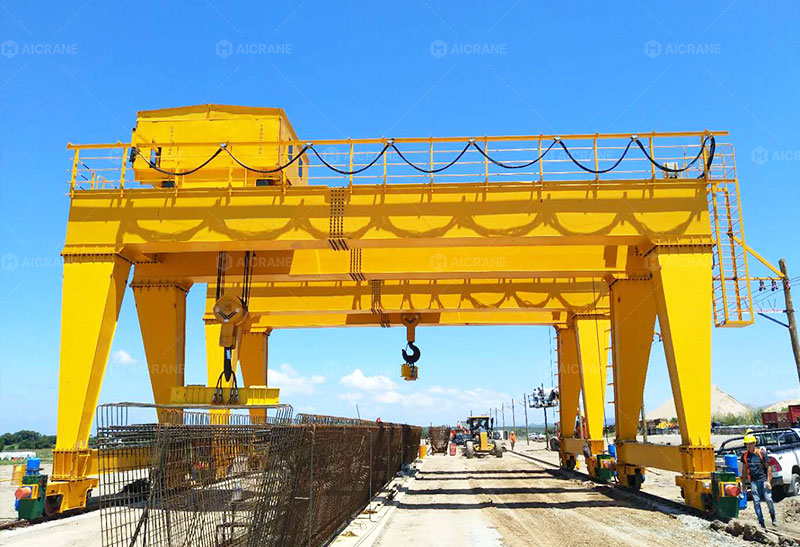
Precast concrete yards are among the most demanding industrial environments for material handling equipment. They involve the continuous movement of heavy, oversized, and often irregularly shaped concrete elements such as beams, slabs, wall panels, bridge segments, and foundation components. To handle these loads safely and efficiently, gantry cranes are widely used as the primary lifting solution.
One of the most frequently asked questions by project planners and engineers is: What is the standard gantry crane capacity for precast concrete yards?
The answer is not a single fixed number. Instead, it depends on production scale, component size, yard layout, and handling strategy. However, in practical industry applications, there are well-established capacity ranges that can guide selection and design.
This article explains standard gantry crane capacities in precast yards, the reasons behind these ranges, and how to choose the right system for efficient long-term operation.
1. Why Gantry Cranes Are Essential in Precast Concrete Yards
Precast yards require repetitive lifting of heavy and often long structural elements. Unlike conventional workshops, these yards operate in open environments and need equipment that offers:
- High lifting capacity
- Wide span coverage
- Outdoor durability
- Mobility along production lines
- Flexible handling of different precast shapes
Gantry cranes are ideal because they can operate without building support structures and can be designed to travel along rail tracks or rubber-tyred systems depending on site requirements.
They are commonly used for:
- Demolding and lifting precast elements from casting beds
- Transporting finished products to storage areas
- Loading precast components onto transport vehicles
- Organizing yard logistics and stacking operations
2. Typical Gantry Crane Capacity Ranges in Precast Yards
In real-world precast concrete production facilities, gantry crane capacities generally fall into the following categories:
2.1 Light-Duty Precast Operations (5–20 Tons)
These are used in small or medium precast yards producing:
- Small wall panels
- Lightweight slabs
- Drainage elements
- Minor structural components
A 5–10 ton gantry crane is often sufficient for basic handling, while 15–20 ton systems are used when elements become larger or more frequently handled.
2.2 Medium-Duty Precast Yards (20–50 Tons)
This is the most common capacity range in modern precast facilities.
Typical applications include:
- Large wall panels
- Standard bridge beams
- Precast columns
- Structural slabs for buildings
A 40 ton gantry crane is particularly popular because it provides a strong balance between lifting capacity and operational efficiency.
At this level, cranes are usually designed with:
- Double girder structures
- Multiple lifting speeds
- Advanced anti-sway systems
- Precision positioning controls
2.3 Heavy-Duty Precast Production (50–100 Tons)
Large infrastructure projects require heavier lifting capacity.
Applications include:
- Bridge girders
- Large T-beams
- Box culverts
- Tunnel segments
- Industrial precast structures
At this level, cranes must handle:
- Long span loads
- High bending moments
- Complex lifting rigging systems
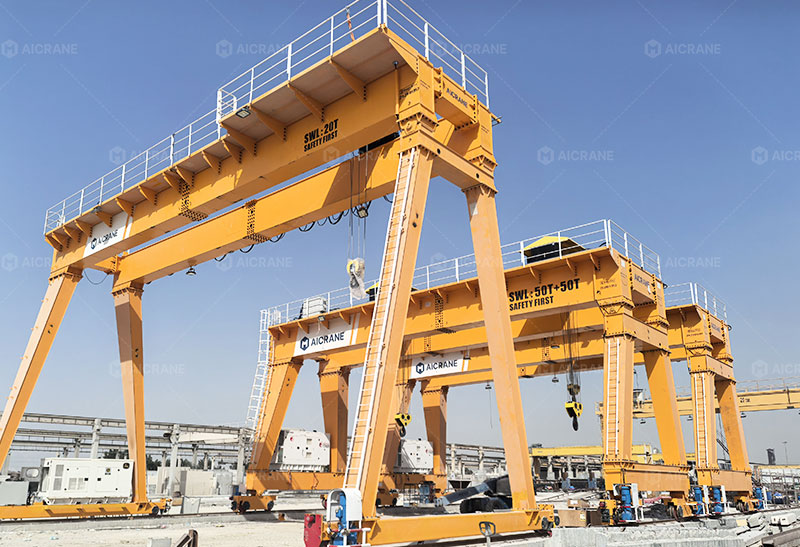
Heavy-duty gantry cranes are often equipped with synchronized hoisting systems or twin hoist configurations to distribute load safely.
2.4 Ultra-Heavy Precast Operations (100–500 Tons+)
In large-scale infrastructure or specialized precast plants, straddle cranes can exceed 100 tons and reach up to 500 tons or more.
These are used for:
- Massive bridge segments
- Offshore concrete structures
- Large industrial foundations
- Special engineering components
Manufacturers such as Aicrane provide customized gantry crane systems in this range, designed specifically for high-load, high-duty cycle precast environments.
3. Factors That Determine Crane Capacity Selection
There is no universal “standard” capacity because precast yards vary significantly. Several key factors influence the required crane size.
3.1 Weight of Precast Components
The most direct factor is the maximum weight of the heaviest precast element.
However, engineers typically apply a safety margin of 20–30% to account for:
- Lifting rigging weight
- Dynamic lifting forces
- Uneven load distribution
For example: If a precast beam weighs 24 tons, the crane selection may be based on 30 tons or higher capacity.
3.2 Production Scale and Workflow Speed
High-volume precast yards require cranes that:
- Reduce cycle time
- Support continuous lifting operations
- Minimize downtime between loads
Higher capacity cranes often allow faster operations because they reduce the need for multiple lifting cycles or load splitting.
3.3 Span and Yard Layout
The wider the span, the higher the structural stress on the crane.
Key considerations include:
- Rail spacing
- Storage zone layout
- Casting bed positioning
- Transportation lanes
Long-span gantry cranes often require stronger girders and may influence maximum practical capacity.
3.4 Duty Cycle and Operational Frequency
Precast yards operate under high repetition conditions. This means:
- Frequent starts and stops
- Continuous lifting cycles
- High fatigue loading on structural components
Crane duty classification (such as A5, A6, A7) becomes as important as capacity rating.
3.5 Type of Precast Products
Different products require different handling strategies:
- Flat slabs → simpler lifting
- Long beams → require balance control systems
- Complex bridge segments → require multi-point lifting
More complex products often require higher-capacity and more precisely controlled cranes.
4. Standard Crane Configurations in Precast Yards
While capacity varies, there are common configurations used in the industry.
4.1 Single Girder Gantry Cranes (5–20 Tons)
- Lightweight structure
- Cost-efficient
- Suitable for small precast yards
4.2 Double Girder Gantry Cranes (20–100 Tons)
- Most widely used in precast industry
- Higher rigidity and stability
- Supports higher duty cycles
4.3 Synchronized Twin Crane Systems (50–500 Tons+)
- Two cranes working in coordination
- Used for oversized precast elements
- Enhanced load balancing control
5. Importance of Precision and Stability in Precast Lifting
Precast concrete elements are not only heavy but also fragile in certain stress directions. Unlike steel, concrete has low tensile strength and can crack if uneven force is applied.
Therefore, heavy duty gantry cranes used in precast yards must ensure:
- Smooth acceleration and deceleration
- Anti-sway control systems
- Precise load positioning
- Even load distribution across lifting points
Even a minor imbalance can cause structural damage to expensive precast components.
6. Role of Modern Technology in Capacity Optimization
Modern gantry cranes increasingly use smart systems to improve performance:
- Variable frequency drives (VFD) for smooth control
- Load monitoring sensors
- Digital anti-sway systems
- Automated positioning systems
- Remote diagnostics and maintenance alerts
These technologies allow cranes to safely handle higher loads with improved precision and reduced operator strain.
7. How to Choose the Right Capacity for Your Precast Yard
To select the correct gantry crane capacity, follow these steps:
- Identify the heaviest precast element
- Add safety margin (20–30%)
- Evaluate production volume requirements
- Analyze yard layout and span requirements
- Consider future expansion needs
- Match duty class with operational frequency
A well-balanced selection avoids both underperformance and unnecessary investment.
Conclusion
There is no single “standard” gantry crane capacity for precast concrete yards, but industry practice clearly shows a structured range:
- 5–20 tons for light-duty precast operations
- 20–50 tons for most medium-sized precast plants
- 50–100+ tons for heavy infrastructure components
- 100–500+ tons for large-scale or specialized engineering projects
The correct choice depends on product weight, production intensity, yard design, and long-term operational goals.
Ultimately, selecting the right capacity is not just about lifting ability—it is about ensuring safe handling, production efficiency, and long-term structural reliability in a demanding precast environment.